

BMW launched the K-series in the early 1980s. These motorcycles are powered by a longitudinally mounted, horizontally positioned inline three- or four-cylinder engine. Even today, the K-series has a reputation for being almost indestructible, and mileages well beyond 200,000 km are not unusual. That is why so many of these motorcycles are still on the road despite their age.
The BEP3.0 was developed for riders who want to replace the original instrument cluster — the famous “Lunch Box” — on a K75, K100, K1100 or K1 with an aftermarket speedometer. No stress, soldering or wiring mess. With the BEP3.0 the conversion is 100% reversible: no modification of the wiring loom or the motorcycle is required. Just plug it in and ride.

The BEP3.0 can be connected to all K75, K100, K1 and K1100 models, regardless of the fuel-level sensor, LT/RT/RS version or whether ABS is fitted. The relevant signals are evaluated correctly in every case.

By using WAGO lever connectors, screw terminals are deliberately avoided. This makes the BEP3.0 highly resistant to vibration — no more sheared wires or loose terminal blocks.

The BEP3.0 includes logic that detects which fuel-level sensor is installed. Both the older thermistor sensors and the newer float sensors can therefore be evaluated, and the reserve warning works as usual at 4 litres.

Even without an aftermarket speedometer connected, the BEP3.0 provides the essential functions required by the motorcycle, including the alternator/battery charging circuit, turn-signal cancellation and a functioning starter button.

All of the electronics fit into a compact 10.3 × 6.2 × 2.7 cm plastic enclosure weighing only 80 grams.

All BEPs are handcrafted by me in Switzerland. Every board is function-tested after assembly before it is packed and shipped. Swiss quality!

Just plug it in and ride. No soldering iron is required and no wires in the original loom need to be cut. Plug it in, get on the bike and go.

The BEP3.0 provides a separate output for each gear. This makes it easy to build a custom gear indicator with a few LEDs. Ready-made gear indicators may also be available from me in the future.

With all due modesty, I would say the BEP3.0 is the coolest solution for an instrument conversion on a K 🙂
From the low-maintenance shaft drive and electronically controlled fuel injection with overrun cut-off to the aluminium tank, the K-series offers almost everything a rider who simply wants to ride could ask for. The engine is remarkably lively for a motorcycle of its age. It is a great bike — if only there were not the styling. To BMW’s credit, the design is extremely functional, but in my opinion aesthetics suffered from so much “form follows function”. My first step was therefore to remove the fairing. Once that is gone, the huge instrument cluster — affectionately called the “Lunch Box” by K riders — immediately stands out. It rarely suits a custom build and usually has to go.
And that is exactly where the problem starts. Remove it and almost nothing works anymore. The Lunch Box is not just a display; it also performs several essential electrical functions that the K needs in order to run properly.
-The battery is no longer charged
-The starter button no longer works normally (only with the clutch pulled)
-The neutral signal cannot be taken directly from the wiring loom
-The speed signal from the final drive cannot be used directly.
-The RPM signal fluctuates because it is not filtered and digitised
-The 4-litre reserve signal cannot be used directly
-Automatic turn-signal cancellation no longer works
The Lunch Box therefore does much more than display information: it decodes signals (gearbox switch), amplifies signals (speed signal from the final drive), compares signals (4-litre reserve comparator) and also generates signals itself (starter button, alternator circuit, automatic indicator cancellation, etc.).
The BEP3.0 performs all of these tasks in one compact circuit. If your tank does not have a float sensor (early models before 1986), the fuel-level bar display of an aftermarket speedometer cannot show a continuous level. In that case the BEP can only distinguish between full and reserve (4 L), so the display will show either all bars or the final flashing bar. K models from 1986 onward use a float sensor that can be connected directly to the speedometer; the required cable with the matching connector is included. From BEP3.0 onward, the RPM signal is also filtered, digitally conditioned and output as a clean square-wave signal (0 V / 10 V), finally eliminating erratic tachometer needles.
The list below shows which signals enter the BEP3.0 through the BMW connector and which signals are available at the WAGO terminals. Use it to check whether the speedometer you want is compatible with the BEP3.0:
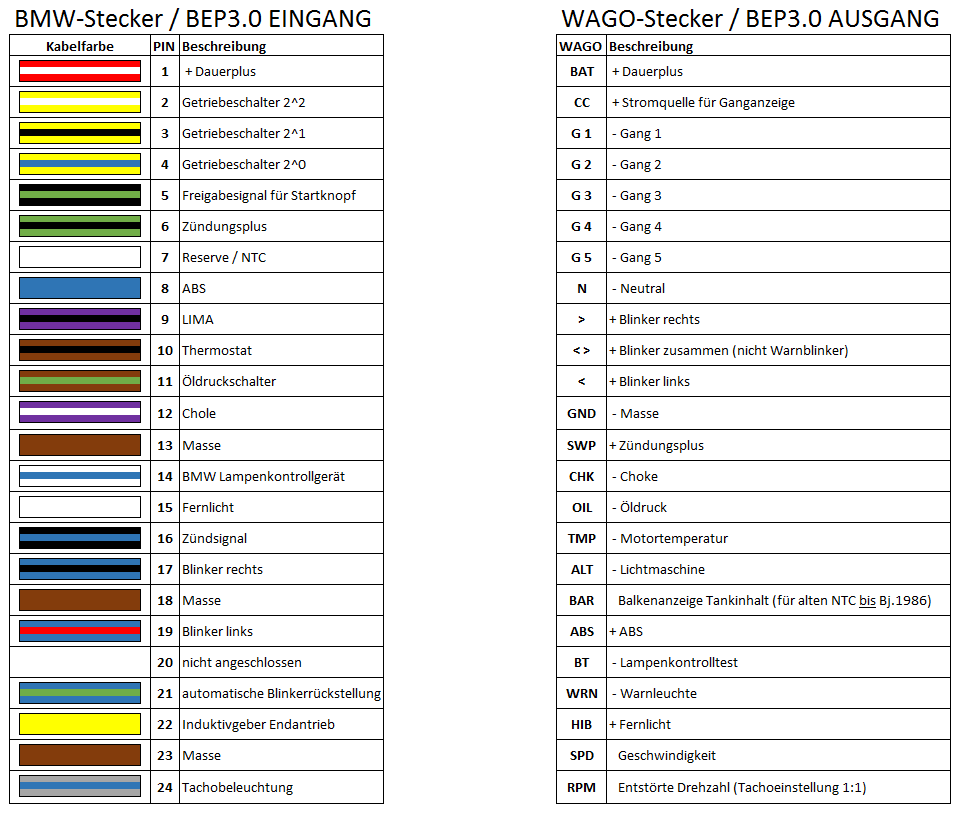

We test our boards with Acewell speedometers. Thanks to our cooperation with Acewell, we receive new models for testing and can adapt the circuit when necessary. For that reason, Acewell is the only brand for which we can guarantee compatibility. Other speedometers should generally work as well, but since we cannot buy and test every model on the market, we cannot make a binding statement for all of them. A list of speedometers reported by customers to work can be found under SUPPORT.
Like the BEP1.0 and BEP2.0, the BEP3.0 is not waterproof. Install it where it is protected from the weather — under the tank or, preferably, inside the K’s electronics box. The BEP3.0 now uses a universal connector that fits both wiring-loom variants. Simply insert the wires from the aftermarket speedometer into the corresponding WAGO terminals. The wires do not need to be tinned; the WAGO connectors are designed for stranded wire from 0.8 mm² to 1.5 mm² and, unlike screw terminals, are vibration-resistant.
You are explicitly allowed to build your own BEP3.0 for non-commercial use. Schematics, documentation and further technical data are available in the official BEP3.0 repository on GitHub: github.com/marukitano.
Everyone has the right to copy. Copying means reproducing useful things — something people have done since the beginning of civilization. In my view, civilization is nothing other than learning from and copying the behaviour of others. What would happen if the use of language were restricted to the few people able to pay the required licence fees? I would not want to live in such a world. Would you?